

--BnK.png)
AI in manufacturing delivers the clearest value in six areas: visual inspection, process anomaly detection, safety monitoring, material and robot logistics visibility, predictive maintenance and production analytics. Each one maps to a KPI your plant already tracks, such as defect escape rate, machine waiting time or unplanned downtime. That lets you compare before and after using your own production data.
Success rarely depends on the AI model alone. It depends on whether cameras, robots, PLCs and monitoring systems can work together. This article is for plant managers, operations heads, IT/OT leads and robot companies: for each use case, you will see the data it needs, the KPI to track and how to start with a small proof of concept.
How is a smart factory different from factory automation?
An automated factory executes what it was programmed to do; a smart factory uses data from that same process to detect problems and adjust. A welding robot following a fixed path is automation. A system that notices unusual welding current and flags it before a weld fails is a smart factory
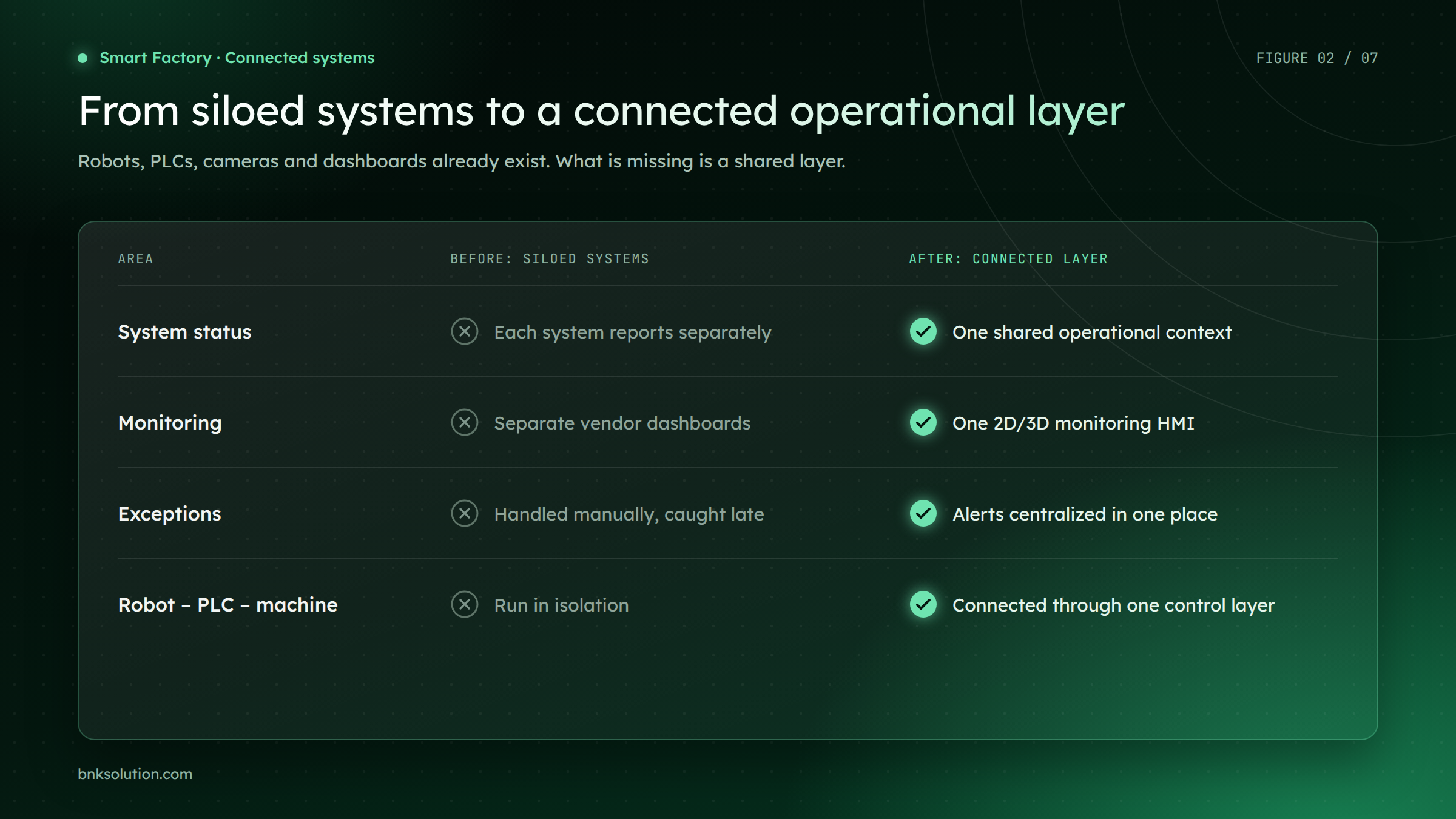
From siloed systems to a connected layer where vision, control, operations data and the HMI share one context
Many plants already run robots, PLCs, cameras and dashboards, but each system reports its own state. Operators switch between several vendors' tools to run one line. Exceptions, such as a robot blocked in an aisle or a machine waiting for a mold, are still handled manually.
So the move to a smart factory rarely starts with buying more equipment. It starts with a connecting layer where camera vision, machine status, robot commands and operator monitoring share one operational context.
Which 6 AI use cases deliver measurable value in a factory?
The six use cases below were chosen because each ties to a specific operational KPI.
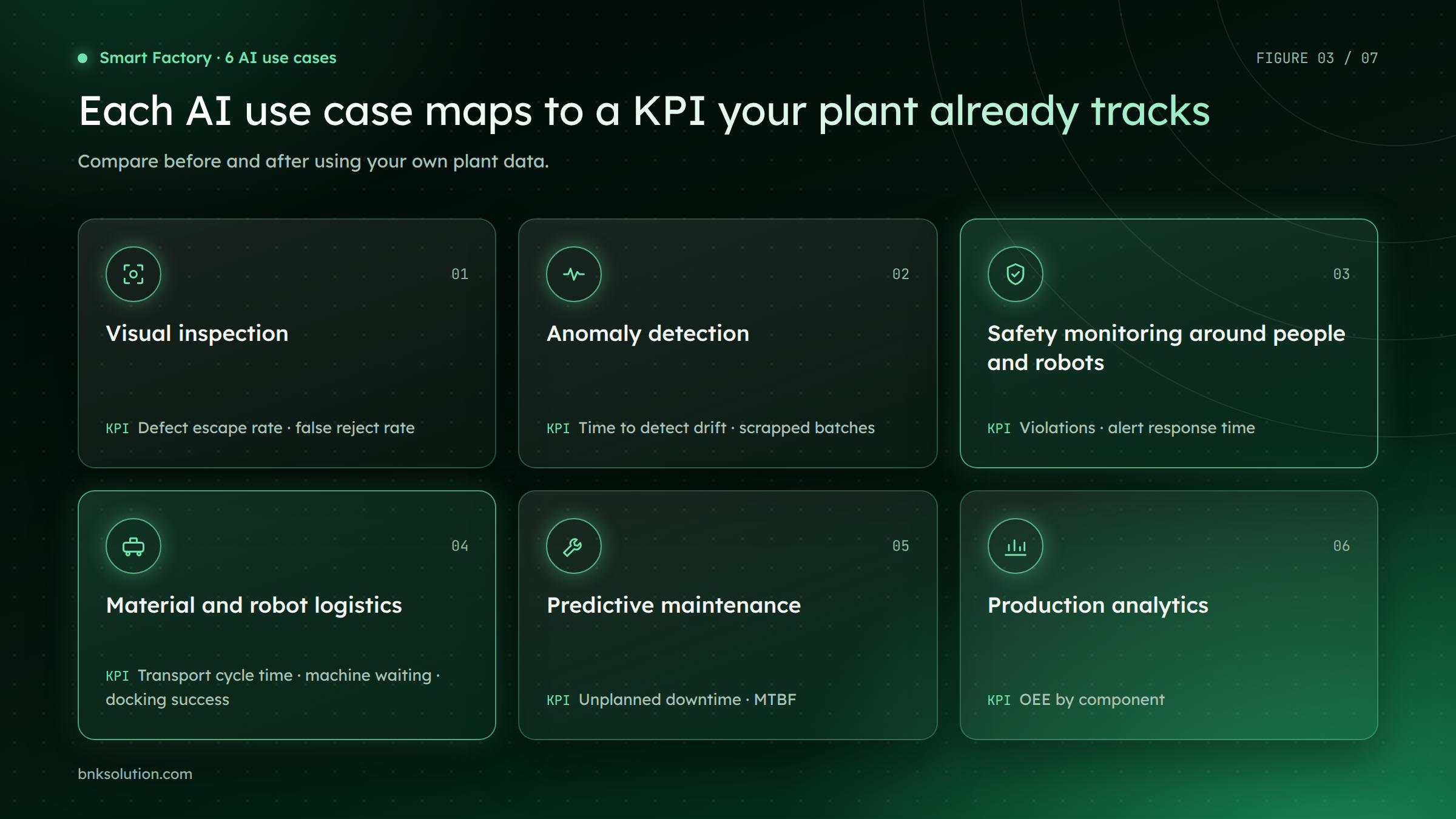
Six AI use cases in manufacturing and the KPI used to measure each one
1. AI visual inspection
AI visual inspection uses cameras and computer vision models to detect scratches, dents, color deviations or missing parts directly on the line. A painting line for equipment housings, for example, can photograph each unit after the curing oven and flag paint runs that inspectors tend to miss on night shifts. Track defect escape rate and false reject rate together, because an oversensitive model cuts escapes while rejecting good parts.
2. Process anomaly detection
Anomaly detection learns the normal pattern of parameters such as pressure, mold temperature and spindle speed, then alerts when their combination drifts. In injection molding, mold temperature and injection pressure can drift slowly within tolerance until flash defects appear across a batch. Fixed alarm thresholds tend to miss this kind of drift, because each parameter on its own stays within limits.
3. Safety monitoring around people and robots
AI object and human detection on camera footage identifies people entering robot or forklift zones, or missing PPE, and raises alerts on site or to the shift supervisor. One principle must hold: AI is an added layer, not a replacement for certified safety devices; robot safety controllers and emergency-stop systems stay independent. Footage of employees is personal data, so retention and access rules must be agreed before cameras go up.
4. Material and robot logistics visibility
When a plant uses AMRs or AGVs to move materials, molds or work-in-progress, the daily questions are: where is each robot, what is it doing, and why did it stop? Onboard sensors can struggle with lighting changes, reflective floors, moving obstacles or occluded areas. Fixed cameras combined with AprilTags add an external positioning layer that complements, rather than replaces, the robot's own sensors
.png)
One mold delivery, step by step: task assignment, camera-based positioning, handling an exception when a person is in the aisle, and docking at the machine (concept illustration).
Instead of sitting in separate vendor dashboards, robot status, routes, tasks, alarms and control commands come together in one monitoring view, as a 2D map or a 3D model of the shop floor. Operators can see at once which robot is blocked or running low on battery, and act from the same screen. Useful KPIs are transport cycle time, machine waiting time, docking success rate, robot utilization and alert response time. These capabilities are part of BnK's Smart Factory AI & Robot Control Services.
5. Predictive maintenance
Predictive maintenance combines vibration, temperature and current data with failure history to estimate when equipment is likely to fail. It needs more time to accumulate data than other use cases, because the model must see enough real failures. Start with bottleneck equipment, where each hour of downtime costs the most.
6. Production analytics
Production analytics combines machine, MES and ERP data to show why OEE is low: stoppages, slow cycles or defects, on which shift and for which product. The result often guides the next investment. If most losses come from machines waiting for materials, logistics visibility is the logical priority. See also BnK solutions for industrial manufacturing.
Running AMRs or AGVs in your plant? See BnK's 2D and 3D robot fleet monitoring HMI concept demos in a short session. Book a demo
What infrastructure does AI in manufacturing require?
You need four connected layers plus an operations management layer on top. A modular design lets you start with one part, such as cameras and a monitoring screen, and expand later
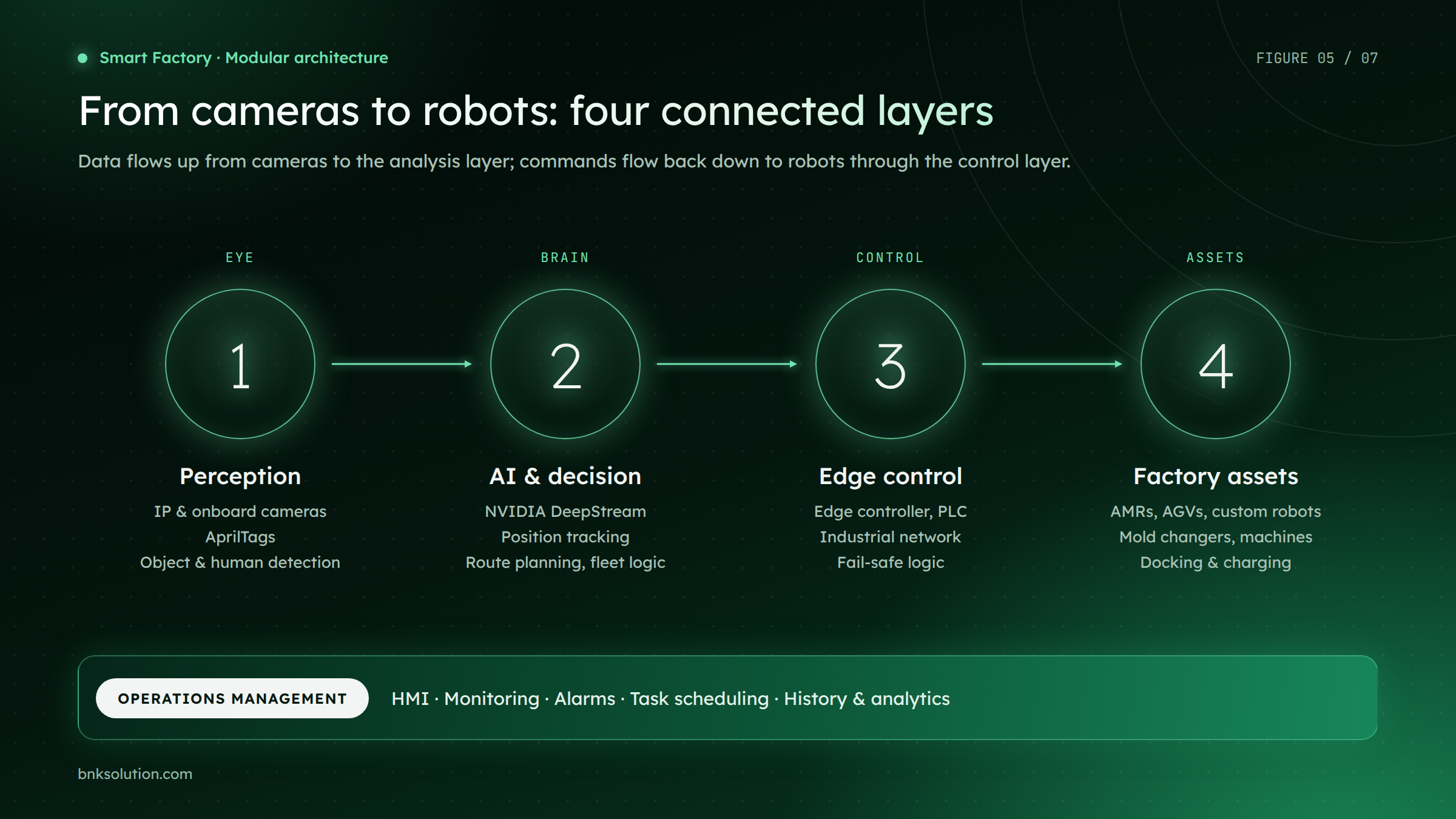
A four-layer architecture: perception, AI and decision, edge control and factory assets, plus operations management
Data flows up from cameras to the analysis layer; commands flow back down to robots through the control layer. Use cases that need an immediate response, such as safety alerts or robot positioning, should run on AI servers on site so footage never has to leave the plant. With many IP cameras, the hard part is usually performance: BnK designs pipelines on NVIDIA DeepStream and GStreamer, optimizes models with TensorRT, adjusts frame rates per stream and balances latency against throughput on the GPU.
Before any production rollout, three sets of conditions should be agreed with the plant:
Functional safety boundaries: existing safety controllers and emergency stops remain in place; manual override behavior is defined.
Operational resilience: behavior on communication loss, camera or server failure, alert and recovery workflows, fallback operating mode.
Cybersecurity: network segmentation, role-based access control, secure API and credential management, logging and controlled remote support.
What does a real smart factory project look like?
At an injection molding plant (customer name withheld), BnK built a camera-based robot management system. It addressed three problems: factory-wide robot visibility, vision-based localization and obstacle detection, and server-to-robot control for precision docking.
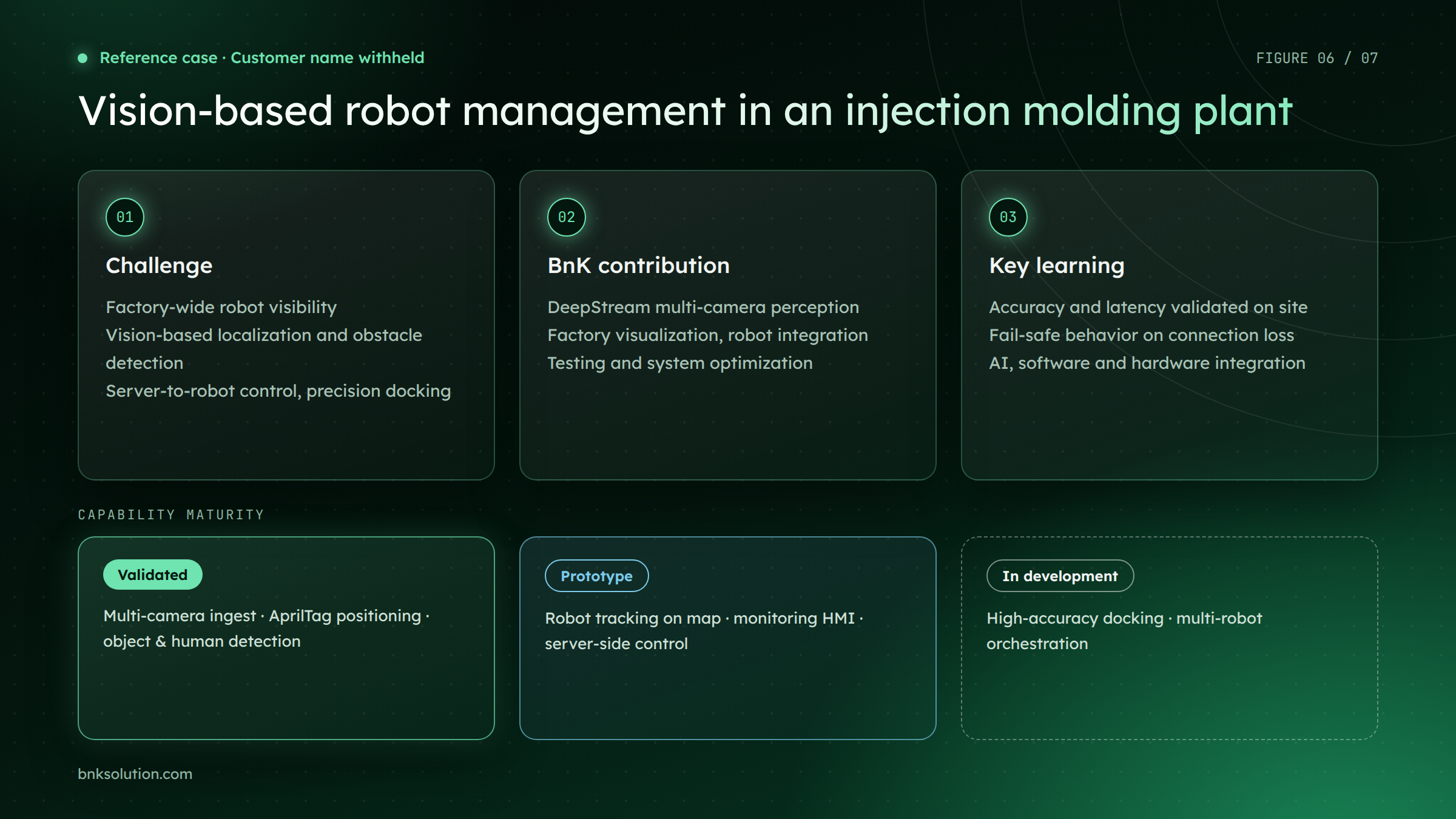
Reference case at an injection molding plant: challenge, BnK's contribution, key learnings and capability maturity
BnK delivered multi-camera perception on DeepStream, factory visualization, robot integration, and testing and system optimization. The clearest lessons: accuracy and latency must be validated under real shop-floor conditions, and server-to-robot communication needs fail-safe behavior when the connection drops.
In this project, multi-camera ingest, AprilTag calibration and positioning, and object and human detection have been validated; robot tracking on the factory map, the monitoring HMI and the server-side control loop are at prototype stage; high-accuracy docking and multi-robot orchestration are in development. Validated capabilities can serve as the foundation for the next PoC, while the rest need further validation under each plant's conditions.
Why start with a PoC, and where should you begin?
A PoC validates a use case under your plant's real conditions before you commit budget to scale. BnK recommends starting with one robot workflow and a focused PoC that tests four things: system interfaces, operational reliability, recovery behavior when something fails, and measurable business value. The path has three stages:
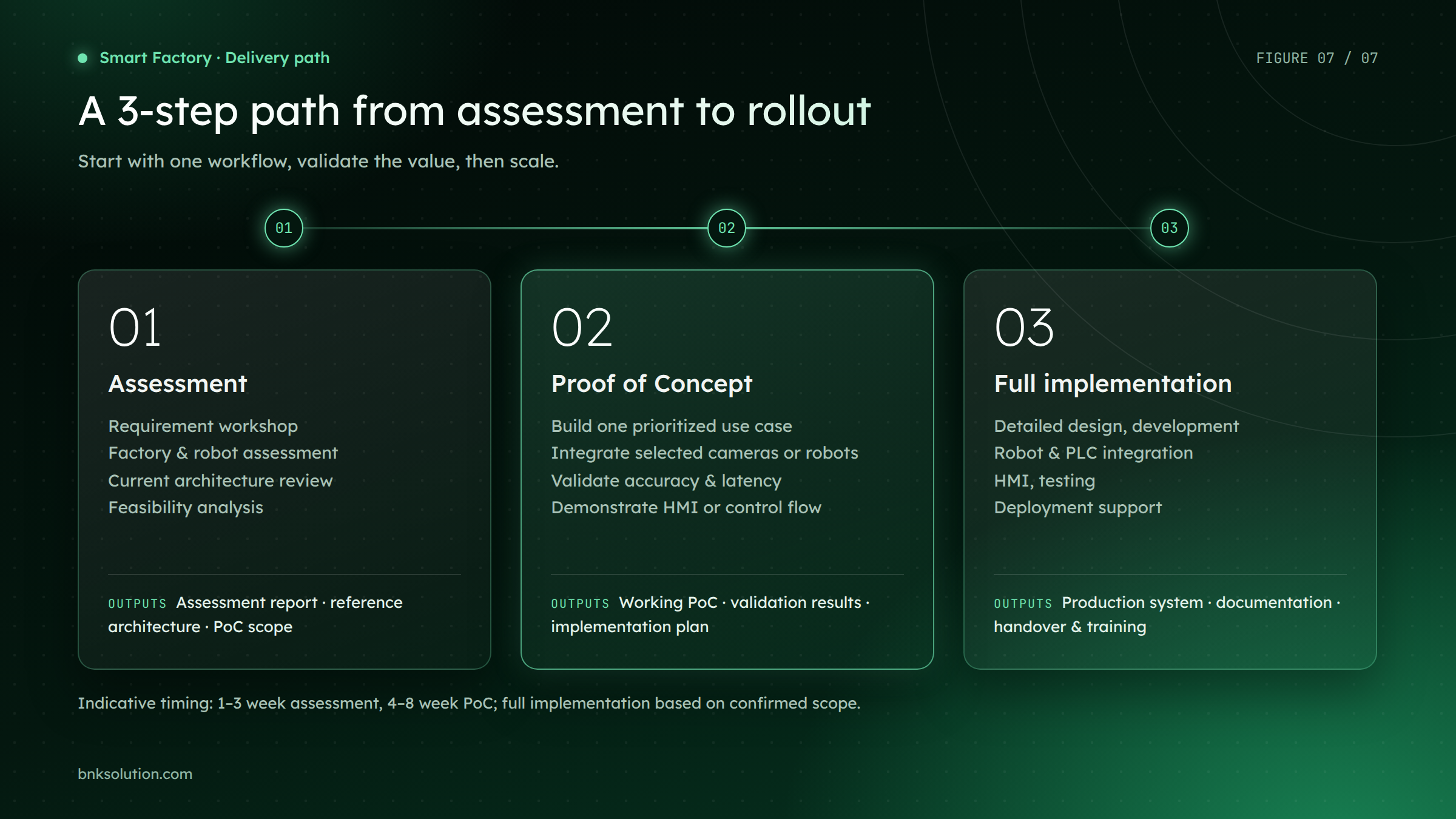
A three-step path: assessment, proof of concept and full implementation
Assessment: requirement workshop, factory and robot assessment, current architecture review, feasibility analysis. Outputs are an assessment report, reference architecture, PoC scope and effort estimate.
Proof of concept: build one prioritized use case, integrate selected cameras or robots, validate accuracy and latency, demonstrate the HMI or control flow, identify scale-up risks.
Full implementation: detailed design, software development, robot and PLC integration, HMI, testing, deployment support, handover and training.
In BnK's current delivery model, the assessment typically takes 1–3 weeks and the PoC 4–8 weeks; full implementation timing and cost are defined by scope after the assessment. The right entry point depends on your context:
Your context | Your priority | Recommended entry point |
Manufacturers with existing robots | Factory-wide visibility, less manual coordination, robots connected to machines and production systems | Factory automation assessment |
Robot manufacturers and solution providers | Add localization, monitoring, control and factory integration | Technical workshop or focused PoC |
AI, technology companies and system integrators | DeepStream and computer vision capacity without building a team in-house | Dedicated engineer or specialist team |
Learn more: BnK Smart Factory solutions · Smart Factory AI & Robot Control Services
FAQ
How much does it cost to implement AI in a factory?
Cost depends on the use case, the number of cameras or robots to integrate, data readiness and the connections required to PLCs or MES. Monitoring one zone has a very different scope from orchestrating a robot fleet. The assessment stage produces a concrete effort estimate before you commit to a PoC.
Can a plant without an MES adopt AI?
Yes, for camera-based use cases such as safety monitoring or robot positioning, which need cameras, an on-site AI server and a connection to the robots. Production analytics relies more on structured production data. Integration with MES and production schedules is a scale-up step, scoped separately for each project.
Does camera footage have to leave the plant?
No. Image processing can run entirely on servers inside the plant, sending only aggregated results out when needed. Storage and remote access are agreed with the plant's IT and security teams before deployment.
Does AI replace a robot's safety devices?
No. Camera-based perception adds information for coordination and alerts, while robot safety controllers and emergency-stop systems keep operating independently. Communication-loss behavior and manual overrides are defined before production use.
Can robots from different vendors be integrated?
Possibly, if the robots accept commands and report status through a control interface; this is confirmed during the assessment. BnK can deliver selected orchestration modules or integrate a control layer around your existing robots, with task assignment, scheduling and robot status management already available as prototypes. Large-scale cross-vendor fleet optimization is still a target capability for BnK, so scope is defined project by project.
Can we hire DeepStream or computer vision engineers only?
Yes. BnK's DeepStream and computer vision capacity is offered independently from the robot solution. Engagement options include a dedicated engineer, a specialist team, technical assessment, PoC development, performance optimization or troubleshooting existing systems. If you also need backend, interface or system integration work, you can combine it with BnK's software development services.
Start with your plant's most important challenge
Want to know how AI can work in your plant and help connect your robots, cameras and machines? Book a session with a BnK consultant!




-1790317058.png)