

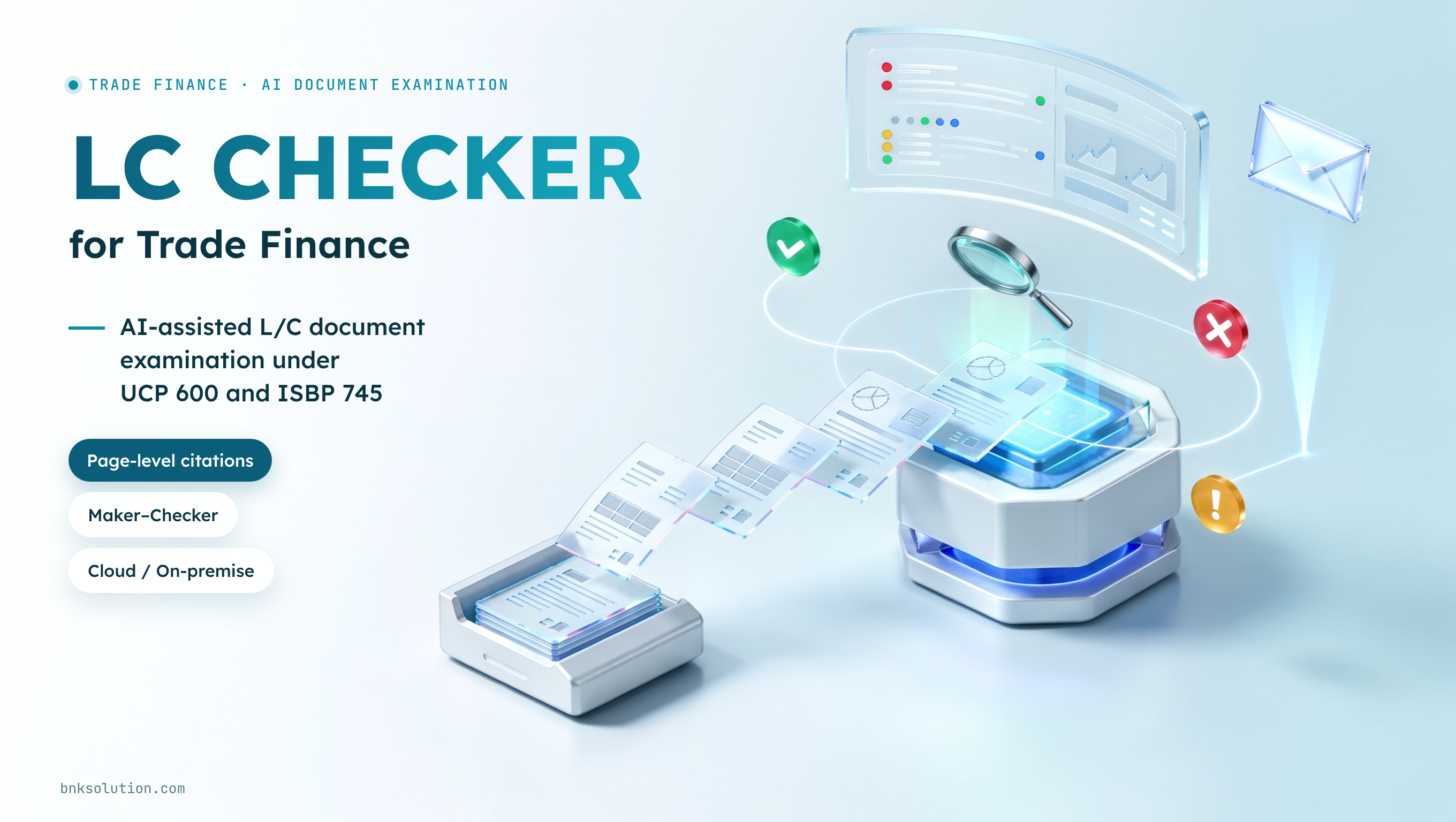
Checking documents under a Letter of Credit (LC) is the most labour-intensive step in trade finance operations. Examiners read every scanned page and check it against the credit, and the bank has at most five banking days to decide. BnK Solution has launched LC Checker, an AI solution that reads and cross-checks the full document set in about 3–5 minutes. Every discrepancy comes with the relevant UCP 600 or ISBP 745 article and its location on the scan. Examiners still make the final call, and the bank's maker–checker control stays intact.
See LC Checker examine a sample document set
LC document checking today: manual, deadline-bound and hard to audit
A typical presentation runs 12–20 pages: draft, commercial invoice, bill of lading, insurance document, certificate of origin and packing list. Examiners read each page, check it against the LC terms and cross-check the documents against each other under UCP 600 and ISBP 745.
Under UCP 600 Article 14(b), a bank has a maximum of five banking days following the day of presentation to examine the documents. If it fails to give notice of refusal in time, it is precluded from claiming that the presentation does not comply (Article 16(f)). A missed discrepancy can lead to payment and dispute exposure, and pencil marks on paper leave no trail for a later review or audit.
Common LC discrepancies
Most discrepancies fall into a few familiar groups. These are the points every examiner checks, and LC Checker checks them against the corresponding articles:
Late presentation: a presentation including an original transport document must be made no later than 21 calendar days after shipment and within the LC's expiry (Article 14(c)).
Invoice goods description does not match the LC (Article 18(c)).
Amount exceeds what the LC allows, including tolerances (Articles 18(b) and 30).
Insurance dated after shipment (Article 28(e)) or cover below the minimum, usually 110% of the CIF or CIP value (Article 28(f)(ii)).
Unclean bill of lading: a clause declaring a defective condition of the goods or packaging (Article 27).
Conflicting data across documents: data need not be identical but must not conflict with each other or with the LC (Article 14(d)).
Missing or incorrect endorsements on transport documents, drafts or insurance documents, as required by the LC and ISBP 745.
How does LC Checker examine an LC document set?
The examiner uploads the full scanned file. LC Checker works through seven steps:
Receive the scan, with no pre-sorting.
Classify and split documents: draft, invoice, bill of lading, certificate of origin, insurance, packing list.
Extract data, with a source citation for every field.
Locate each value on the scan.
Read the presentation form and cover letter.
Run 132 rules under UCP 600 and ISBP 745.
Group findings by issue.
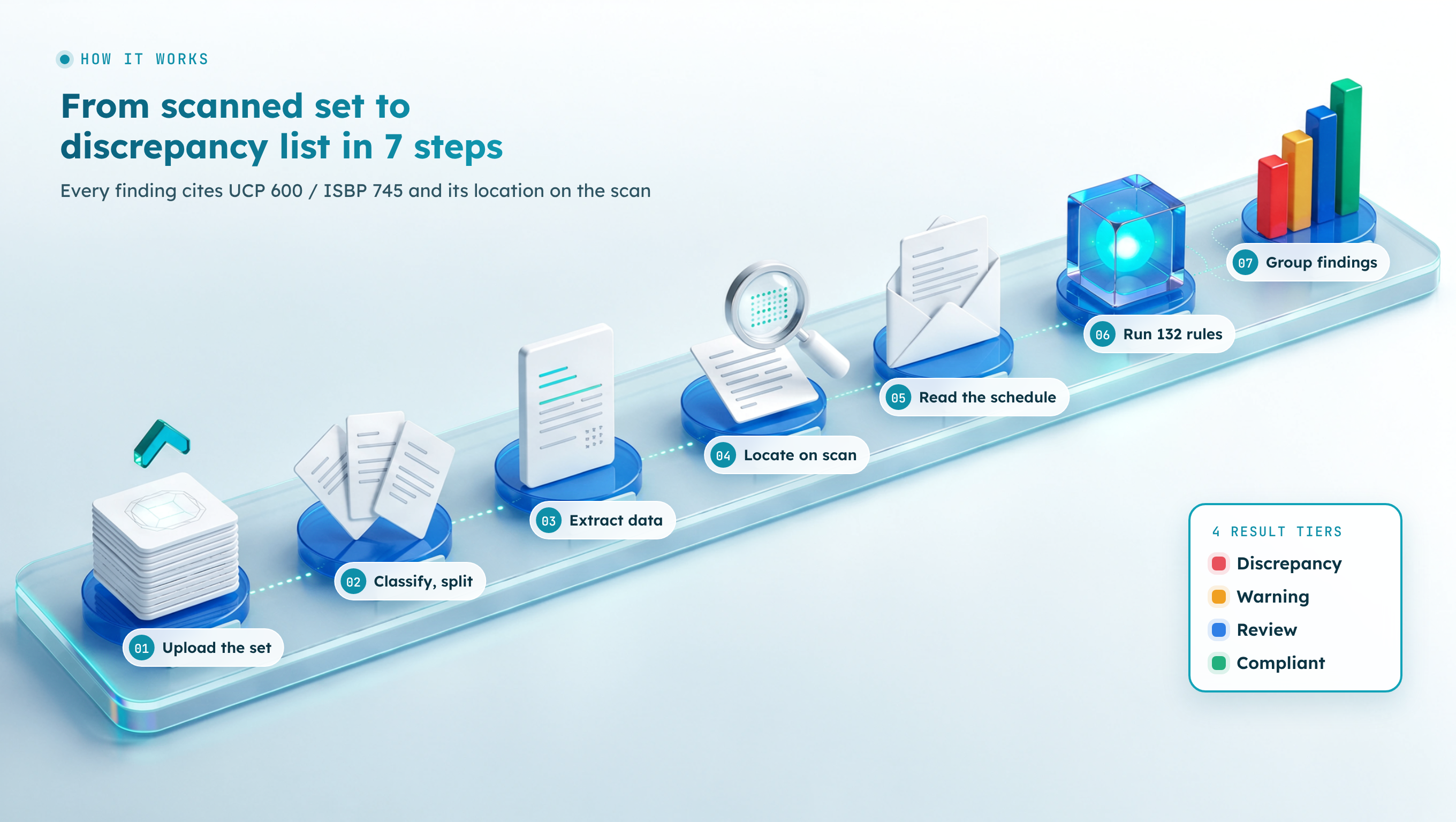
Seven-step AI workflow for letter of credit document checking
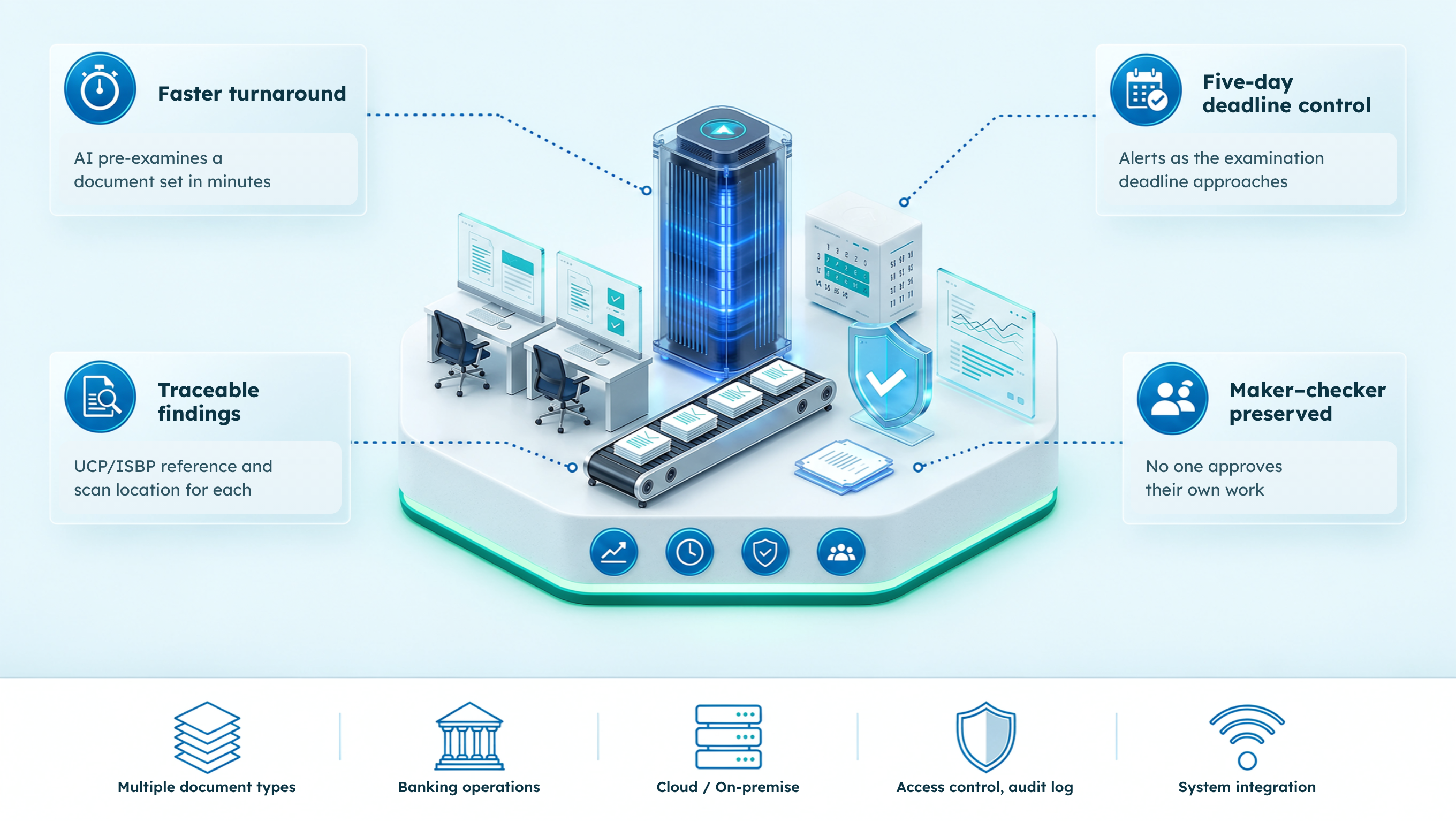
For a 12–20 page set, pre-examination takes about 3–5 minutes. Findings fall into four tiers: Discrepancy, Warning, Needs review and Compliant. Each discrepancy cites its UCP/ISBP article and its location on the scan, so examiners check the evidence instead of rereading the whole set.
Want to see these seven steps on a real document set?
In a 30-minute demo, BnK runs LC Checker on a sample presentation and answers your operational questions.
Key features
Document intelligence
LC Checker classifies and splits the documents in one scanned file, extracts data with source citations and marks each value on the original. Examiners can zoom into any region, read endorsements and view originals in the browser. When AI misreads a value, the examiner corrects it, and the system re-checks and keeps the old value in its history.
UCP 600 and ISBP 745 examination
Each rule maps to a specific UCP or ISBP article, including rules for insurance documents. LC fields 31D, 44C, 45A, 46A and 47A each carry their own pass/fail status. For multi-shipment presentations, documents are grouped by transport document, cross-checked within each shipment and totalled for the full set.
Review on one screen
Findings, the comparison matrix and the original sit on one screen. Digital ticks replace pencil marks, with separate colour layers for makers and checkers. When an examiner waives or overrides a discrepancy, LC Checker records the reason and asks follow-up questions to define its scope. That reason becomes a precedent for the same examiner's future work.
For hard cases, an AI agent running in an isolated environment with no internet access reads the clauses, opens document pages, consults UCP/ISBP and precedents, and recommends a conclusion with evidence. The agent never changes results on its own.
Operations management
The work queue assigns presentations by customer portfolio, with branch-level access control. The five-banking-day deadline is counted against the bank holiday calendar, with alerts as it approaches. The dashboard shows turnaround time, deadline risk, discrepancy rates by customer and rule, AI accuracy based on examiner decisions, and AI cost per presentation.
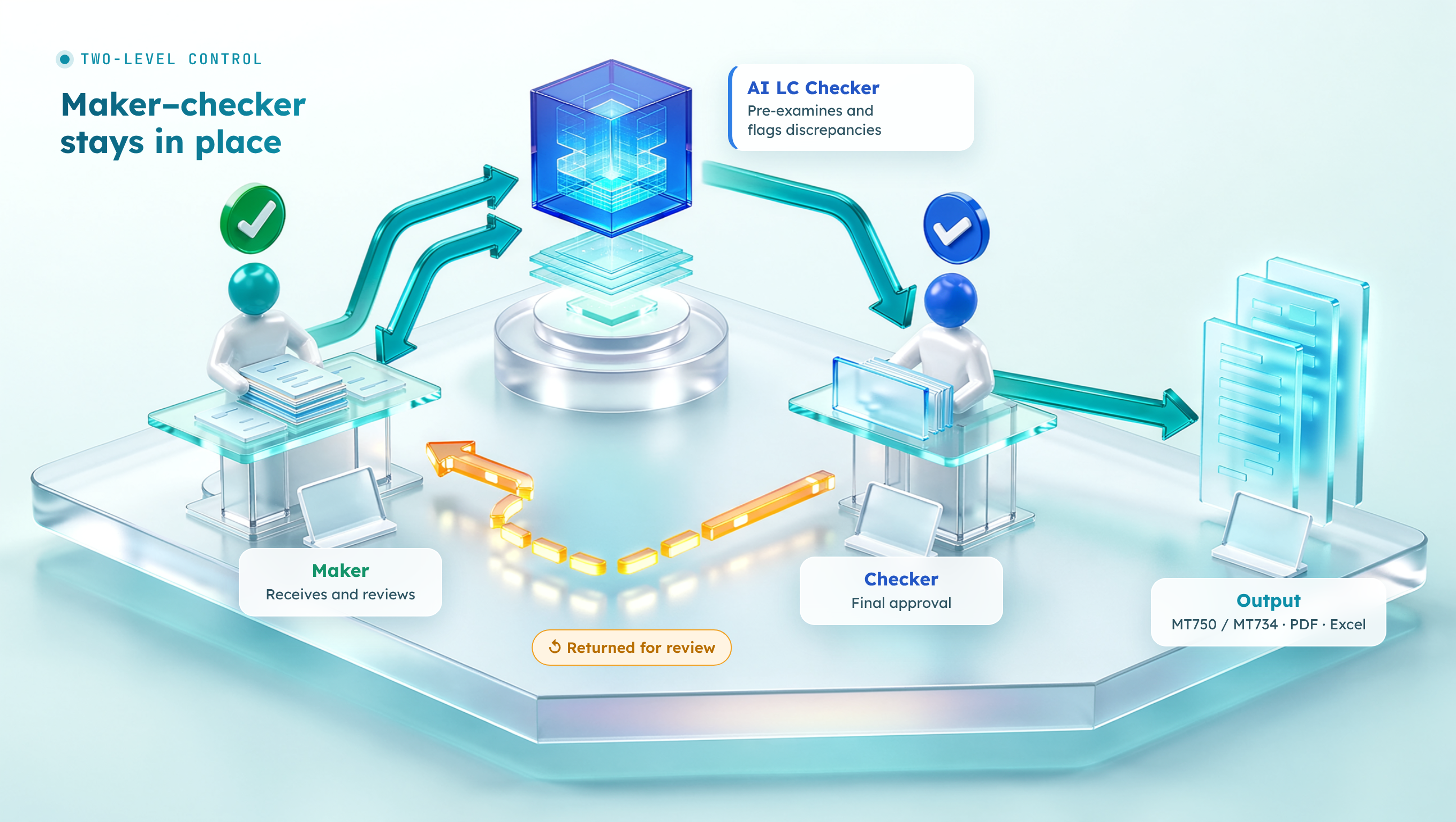
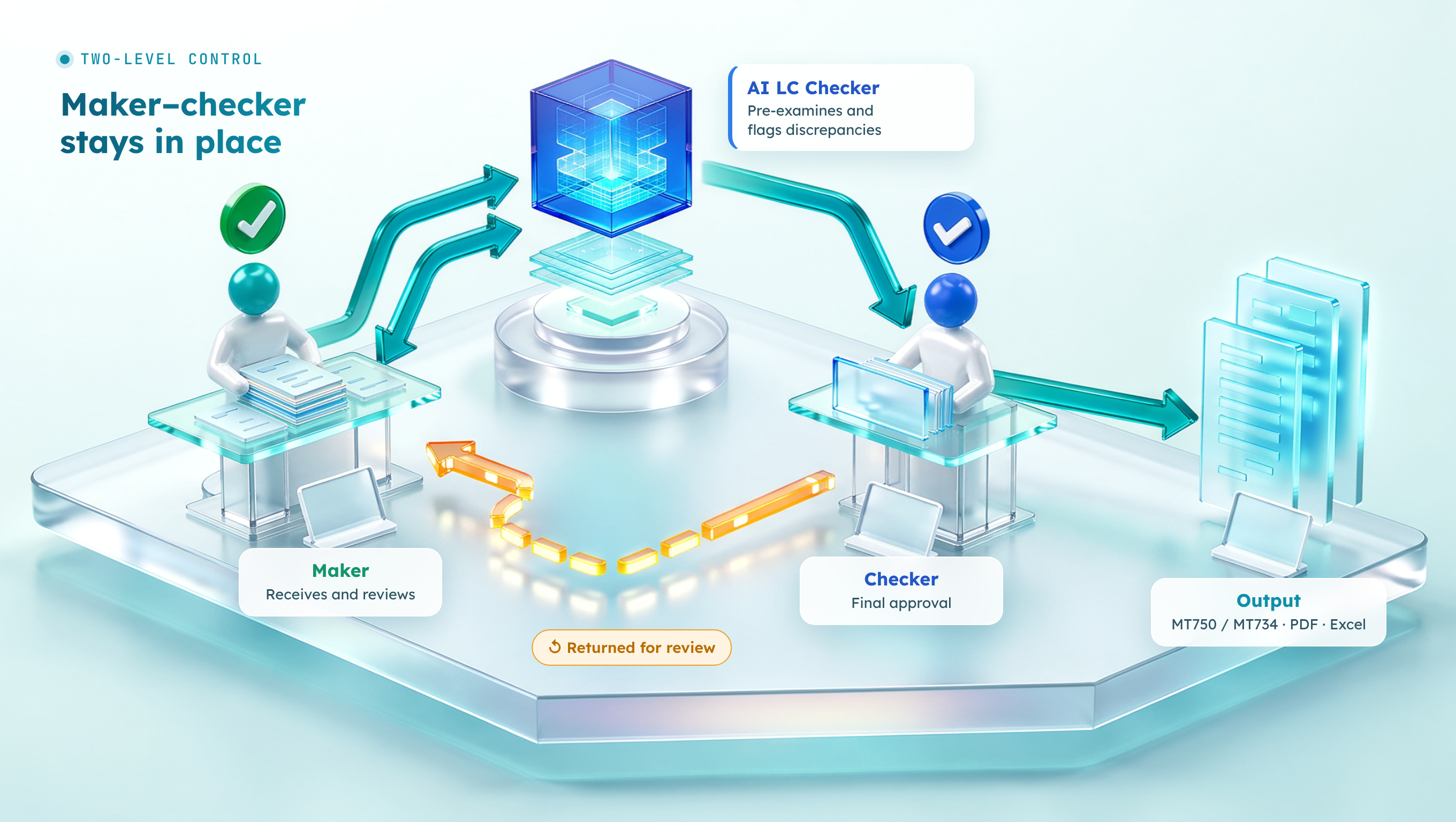
Maker–checker control stays intact
LC Checker does not change the bank's two-level control. Makers confirm, waive or override each finding, correct misreads and submit for approval. Checkers agree or disagree with each finding, then approve or return the set. No one can approve their own work.
Maker–checker workflow for LC document checking in LC Checker
On approval, the LC balance updates automatically. The system pre-drafts MT750/MT734 messages from the findings and exports a PDF checklist and an Excel file. Every action is logged for 10 years, and approved sets are kept permanently.
Benefits for trade finance operations
Task | Current process | With LC Checker |
Data reconciliation | Manual, document by document | LC-to-document matrix with automatic flags |
Rule basis | Manual UCP 600 / ISBP 745 look-ups | Every discrepancy cites its article and source page |
Coverage | Hard to confirm everything was checked | Each item marked as checked |
Discrepancy notices | Drafted by hand | MT750 / MT734 pre-drafted |
Deadline control | Tracked in logbooks | Banking days counted against the holiday calendar |
Work allocation | Assigned manually | Auto-assigned by customer portfolio |
Benefits of LC Checker for trade finance teams
Faster turnaround: AI pre-examines the set in minutes, and examiners review cited findings only.
More capacity with the same team: time saved goes to higher transaction volumes.
Lower payment and dispute risk: the deadline is always visible, and every discrepancy has a UCP/ISBP basis.
Audit-ready: every confirmation, waiver and approval is recorded.
Actual results depend on each bank's volumes and operations, and are measured during a pilot on the bank's own data.
Collections, guarantees and standby LCs
Collections under URC 522: reads collection instructions and drafts MT4xx messages.
Guarantees under URDG 758: reads MT760/MT767 and drafts refusal notices and related messages.
Standby LCs under ISP98.
Security and deployment
LC Checker runs on Kubernetes, with a bilingual Vietnamese/English interface and role-based access for makers, checkers and administrators. Scans are stored privately and visible only to authorized users. Banks deploy in the cloud or on-premises with local AI models. Every AI call passes through a gateway that logs it and records its cost per presentation.
For the cloud option, the bank should assess data residency and outsourcing requirements under its regulator's rules (in Vietnam, the State Bank of Vietnam) before go-live.
Why BnK?
Proven document AI: BnK IDP won the Sao Khue 2025 award and the Make in Viet Nam award.
Banking experience: BnK has delivered an AI suite for letter of credit processing at a bank in Vietnam.
Security and quality: operations certified to ISO/IEC 27001 and ISO 9001:2015.
Scale: more than 350 people, with offices in Vietnam, Japan and Singapore.
Lean rollout: deployment engineers work directly with the bank.
Start with a 100-presentation pilot
Assess: review security and data residency with IT and Risk.
Parallel pilot: run 100 presentations over one month alongside the current process, tuned to bank policy.
Train and scale: train makers and checkers, with materials ready.
Scope and timing are agreed after the first conversation.
FAQ: AI letter of credit document checking
How many days does UCP 600 give a bank to examine documents?
A maximum of five banking days following the day of presentation (UCP 600 Article 14(b)). LC Checker counts this deadline against the holiday calendar and alerts the team as it approaches.
Is LC the same as L/C?
Yes. Both are abbreviations of Letter of Credit.
Does AI replace document examiners?
No. LC Checker pre-examines the set and shows the evidence for each discrepancy. Examiners review and decide, and maker–checker control stays in place.
How long does one document set take?
About 3–5 minutes for a 12–20 page set, before the examiner's review.
Can LC Checker run on-premises?
Yes. Banks can deploy on-premises with local AI models, or in the cloud.
How does the pilot work?
The bank runs 100 presentations over one month alongside its current process and measures the results on its own data.
See LC Checker examine an LC document set
In a 30-minute demo, a BnK specialist will:
• Run LC Checker on a sample 12–20 page presentation.
• Show how each discrepancy links to its UCP/ISBP article and its spot on the scan.
• Discuss deployment (cloud or on-premises) and a pilot that fits your bank.