

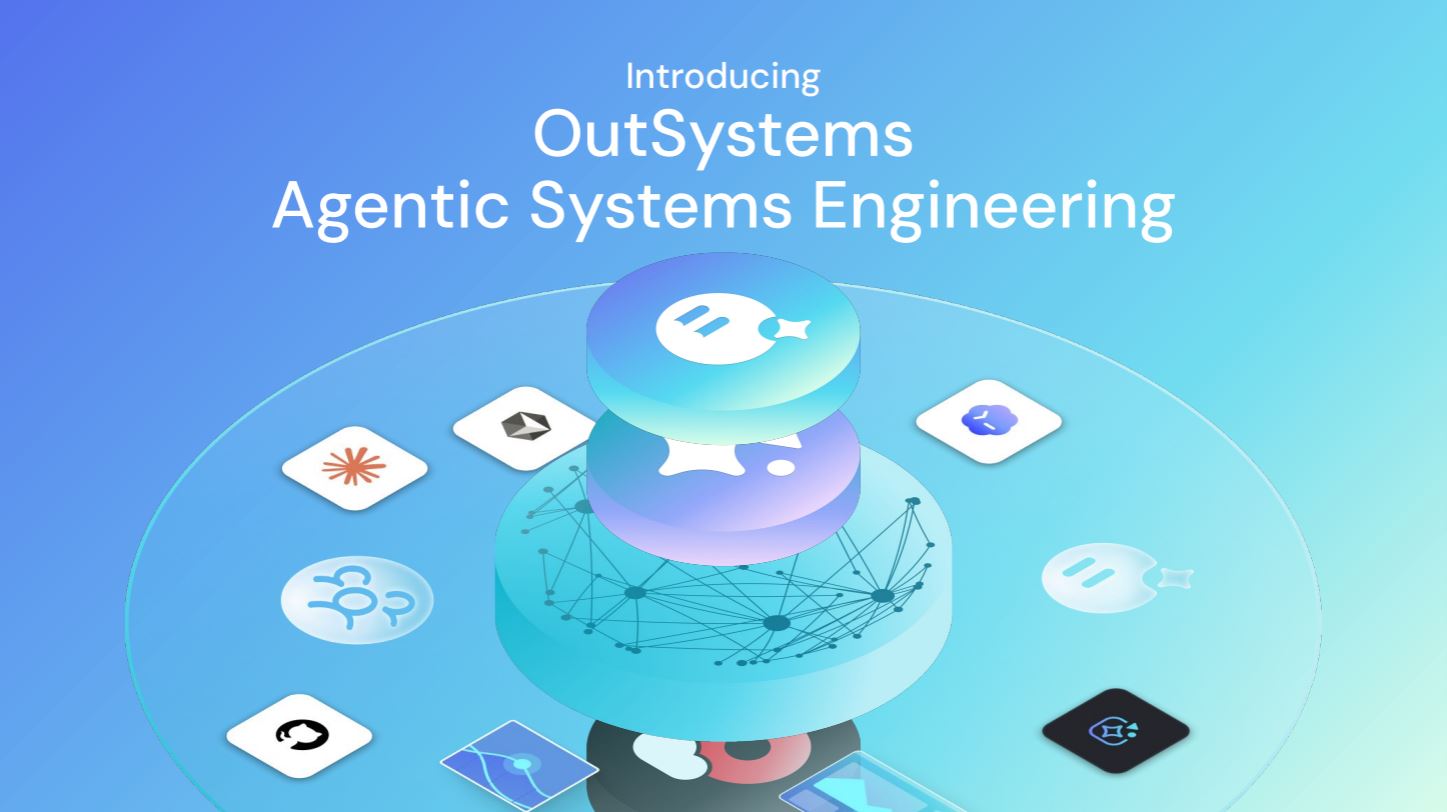
The enterprise software industry just crossed a threshold — and if your IT roadmap does not account for what OutSystems released in March 2026, you may be planning for a world that no longer exists.
Quick Answer: OutSystems Agentic Systems Engineering (launched March 31, 2026) combines the Enterprise Context Graph — a real-time map of all enterprise applications, agents, workflows, and data dependencies — with Mentor AI to deliver AI-speed application development under unified enterprise governance. Existing AI coding tools (Claude Code, Cursor, Copilot) are governed, not replaced. Early access opens Q2 2026.
Key Takeaways
OutSystems launched Agentic Systems Engineering on March 31, 2026 — Q2 2026 early access opens soon
Enterprise Context Graph: real-time dependency mapping across all enterprise apps, agents, workflows, and data
Mentor AI: 50% reduction in development time; handles ~60% of front-end work (SRS Distribution, 2026)
Existing AI tools — Claude Code, Cursor, GitHub Copilot — are governed within the platform, not replaced
Organizations preparing for early access now will be 6–9 months ahead of mainstream rollout by Q4
Why This Announcement Changes the Enterprise AI Calculus
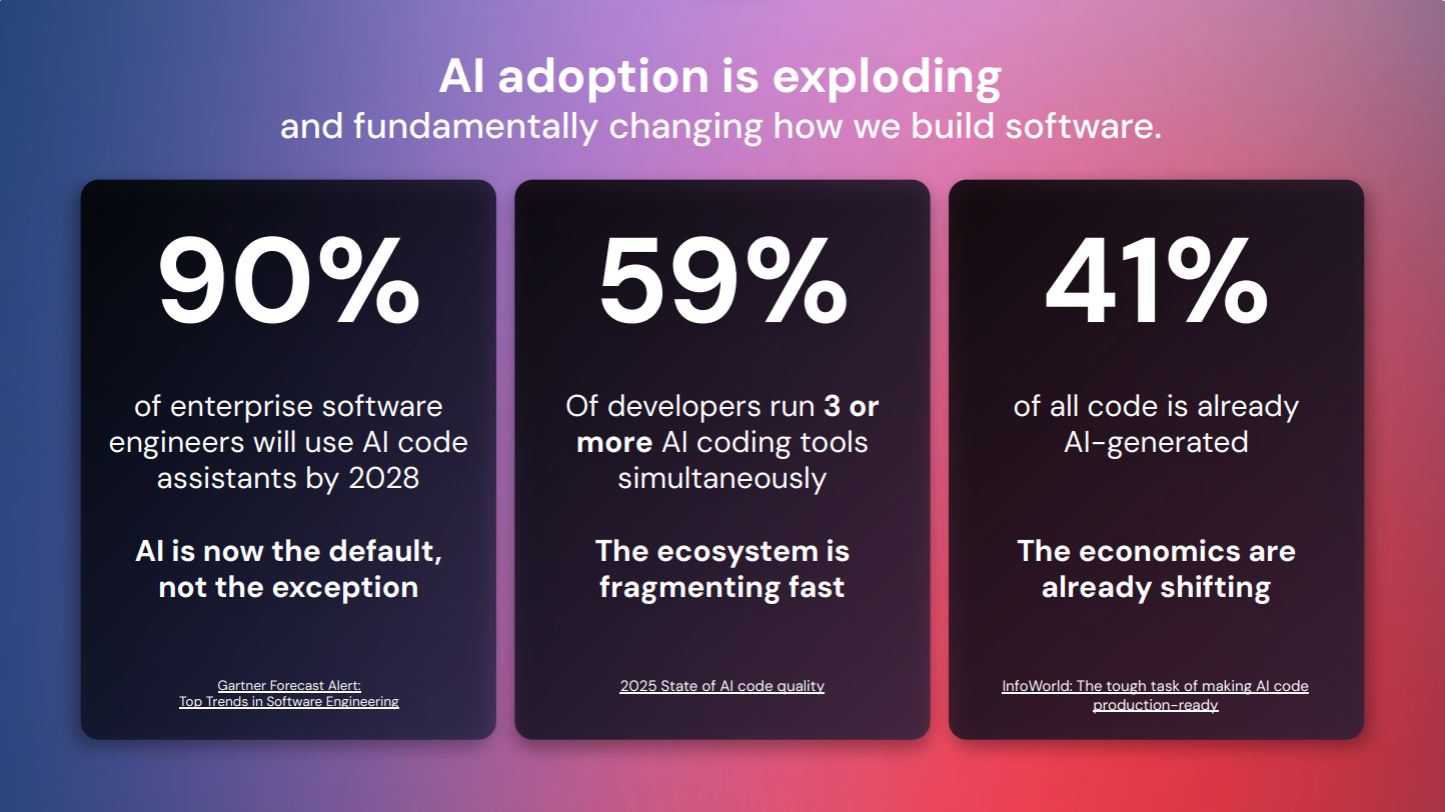
For the past 18 months, enterprise IT leaders have faced a frustrating paradox: AI coding tools deliver dramatic speed gains in isolated environments, but deploying them on mission-critical systems requires governance controls that most tools simply do not offer.
The result is shadow AI accumulating in development shops — teams using unapproved assistants on production-adjacent code, governance debt invisible until a compliance review surfaces it. The gap between what engineering teams can technically build and what the enterprise can responsibly deploy has been widening, not closing.
OutSystems Agentic Systems Engineering is designed to close that gap. Gartner projects the global low-code market will reach $44.5 billion in 2026, driven by a 19% compound annual growth rate. By the same year, an estimated 75% of new enterprise applications will be built using low-code or adjacent technologies. The question for enterprise IT leaders is no longer whether to build faster. It is whether to build faster safely.
What Agentic Systems Engineering Actually Delivers
The March 2026 announcement introduces two foundational capabilities that work together as a unified architecture:
1. Enterprise Context Graph
Think of it as a living map of your enterprise technology stack — updated continuously in real time. The Enterprise Context Graph tracks every application, agent, workflow, data dependency, and system interconnection across your entire environment. When an AI agent or a developer makes a change, it does so with full visibility into downstream impact, operating within predefined enterprise security guardrails.
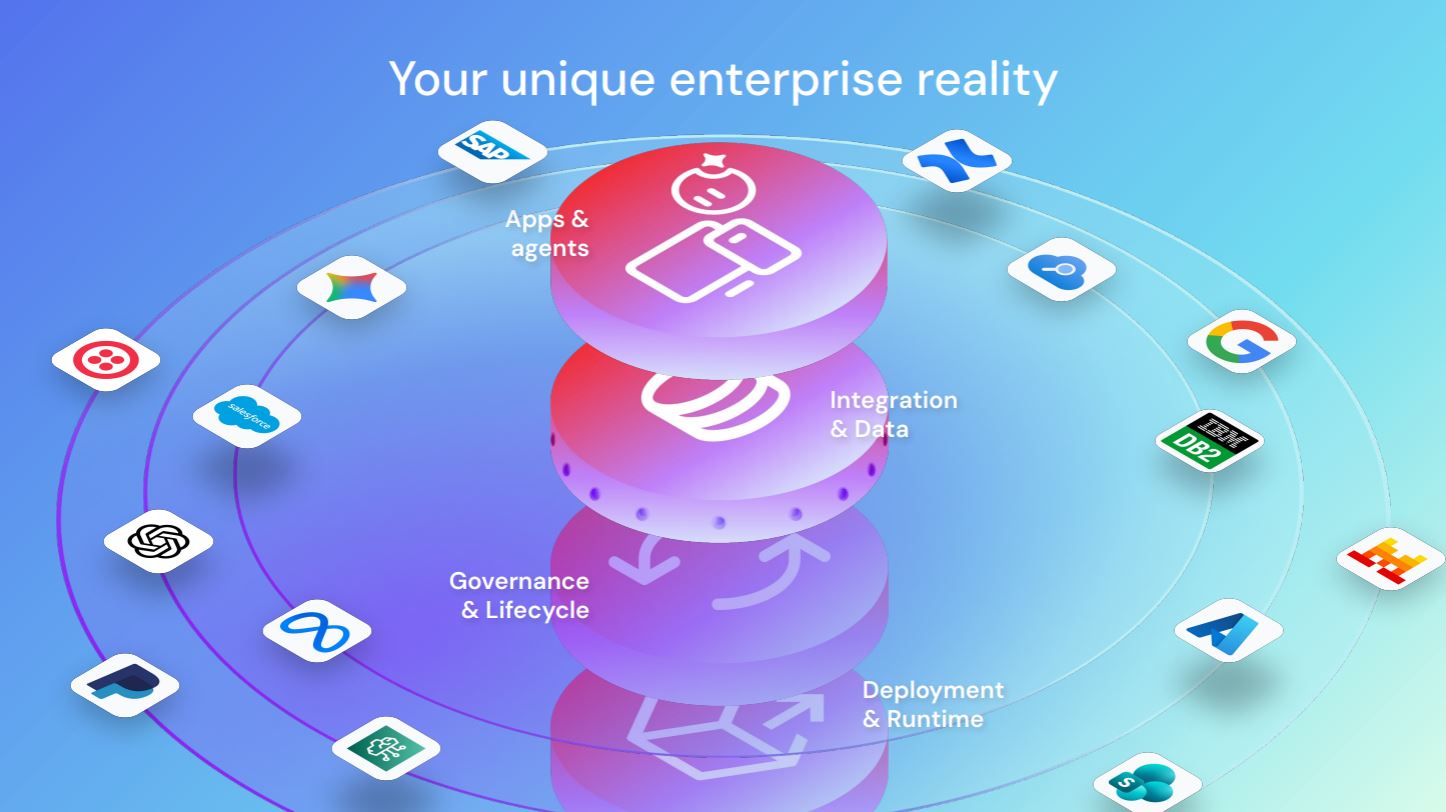
For IT directors managing complex, multi-system environments — integrated core banking platforms, ERP systems, customer portals, and dozens of microservices — this is the capability that has been missing. Most agentic AI low-code platform approaches operate in isolation, generating code without understanding what it touches. The Enterprise Context Graph gives every action — human or AI — the context to operate safely within enterprise constraints.
2. Next-Generation Mentor AI
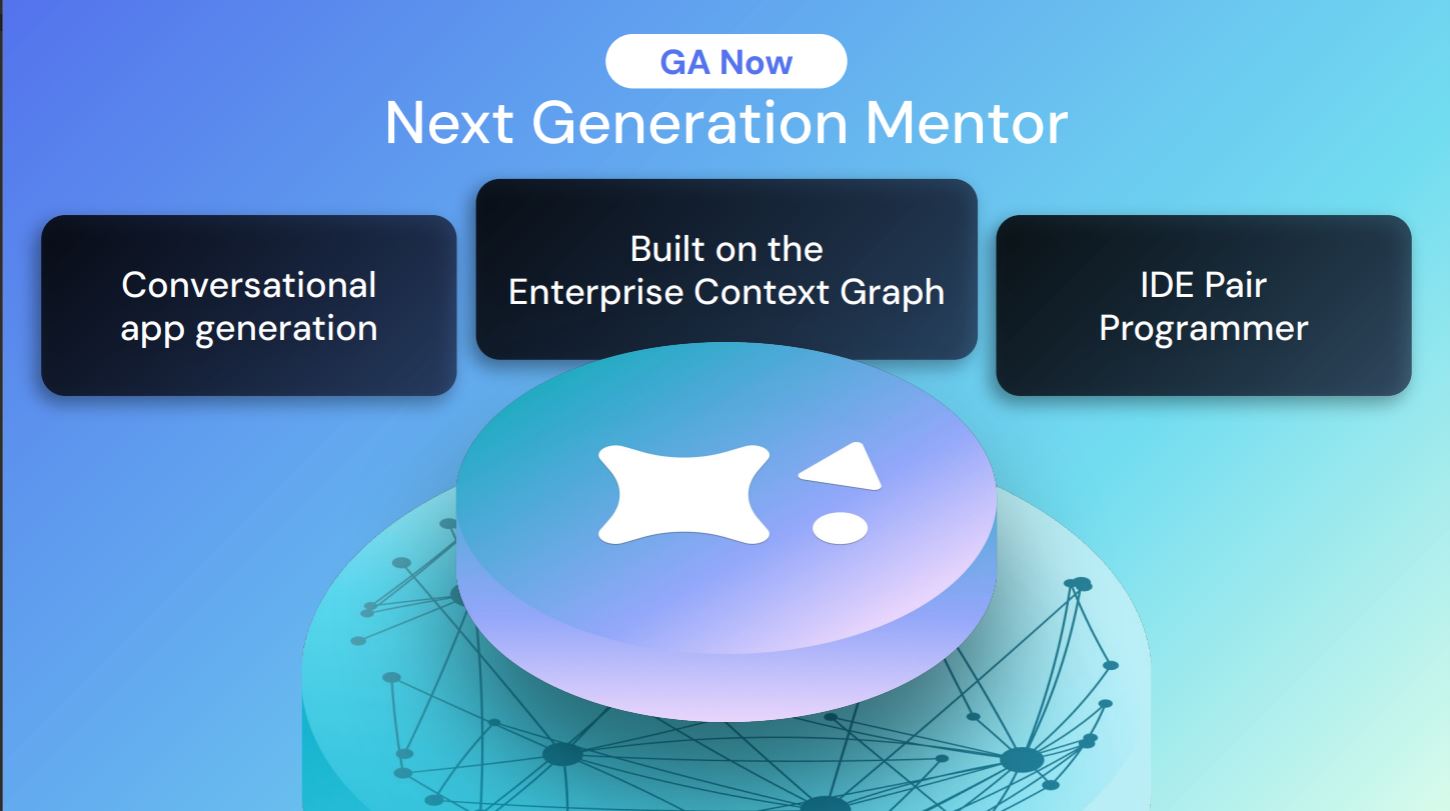
Mentor is OutSystems' in-platform AI assistant, and the Q2 2026 release is a substantial evolution beyond earlier versions. It now delivers:
Conversational application generation — describe what you need in natural language; Mentor builds the foundational structure
Automated documentation and real-time error diagnosis — technical debt addressed at the moment of creation, not months later in code review
Data model and UI screen generation with alignment to enterprise best practices and architectural standards
In-IDE agent capabilities — for development teams already using Claude Code, Cursor, or OpenAI Codex, Mentor acts as the governance and context layer, not a replacement
That last capability is architecturally critical. OutSystems is not asking enterprise teams to abandon their existing AI tools or retrain developers on new interfaces. It is building the governance architecture around them — preserving team velocity while closing enterprise risk.
Open Ecosystem, Closed Risk: The Architecture Decision That Matters
Most enterprise AI governance conversations assume a binary choice: adopt a proprietary, controlled AI environment and accept vendor lock-in, or permit open AI tools and accept ungoverned risk.
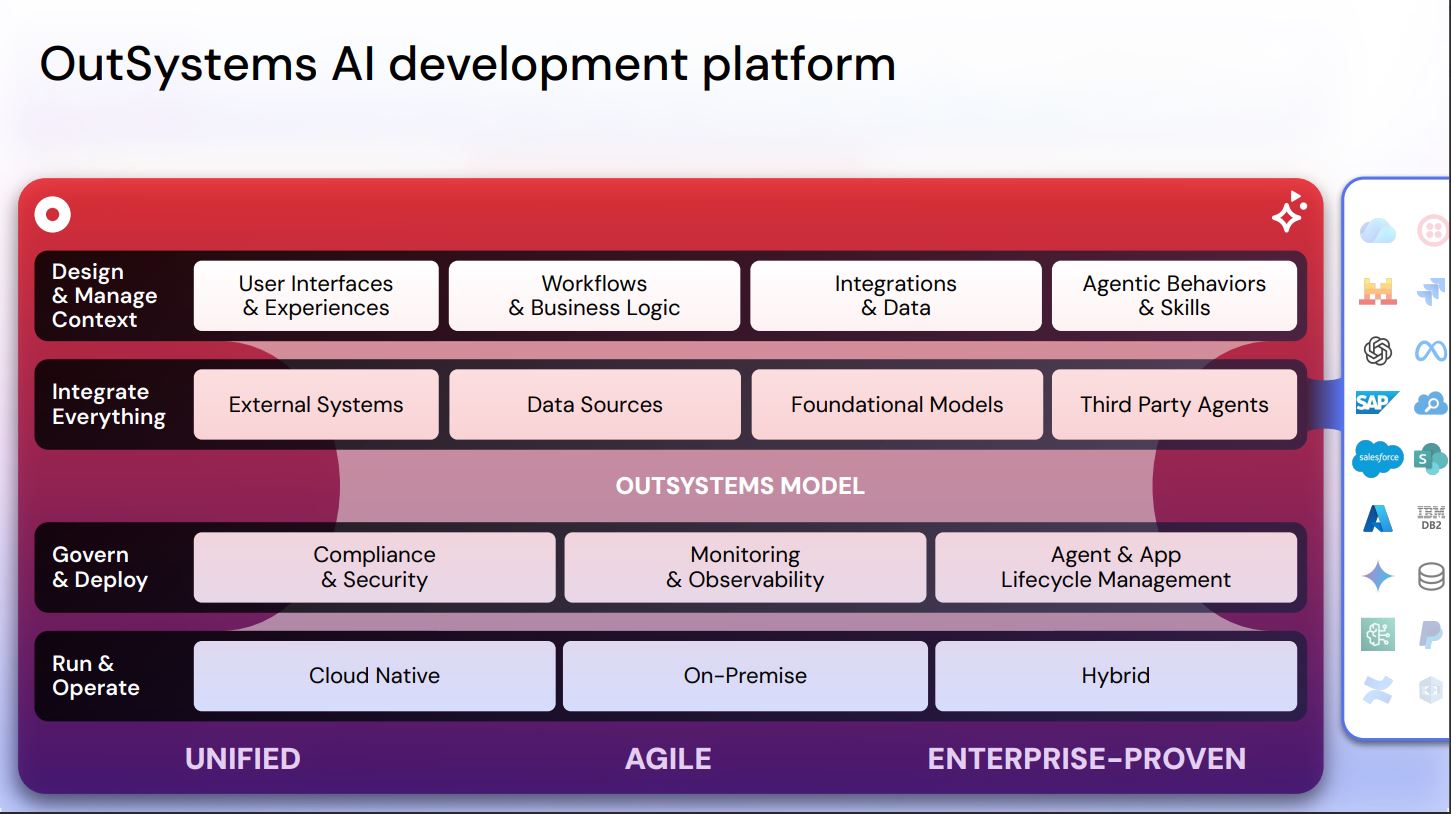
OutSystems Agentic Systems Engineering rejects that framing entirely. Development teams continue using whichever agentic AI tool they are already trained on and productive with — Claude Code, OpenAI Codex, Cursor, or GitHub Copilot. All agentic development activity is then consolidated within the Enterprise Context Graph, where shared security policies, compliance guardrails, and audit trails apply uniformly.
For CISOs and IT risk officers, this architecture separates two previously conflated governance problems: developer tool preference and enterprise compliance posture. Teams choose their preferred coding assistant. The enterprise controls the guardrails that govern every assistant.
This is the model that enterprise leaders across regulated industries — banking, insurance, healthcare, government — have been waiting for.
Early Results: What Enterprise Customers Report
OutSystems disclosed results from customers already operating on Mentor and early Agentic Systems Engineering capabilities at the time of the March 2026 announcement:
SRS Distribution, a large US-based building materials distributor, achieved a 50% reduction in development time after deploying Mentor. A complete time-tracking application moved from concept to production in two weeks. The team reports that Mentor now handles approximately 60% of front-end development work with minimal refactoring required.
Kent State University expects ticket resolution times to drop from hours to minutes by leveraging Mentor for codebase analysis while maintaining full security compliance across enterprise systems.
These outcomes are not from AI-native startups with clean, modern codebases. They are from established enterprises managing legacy complexity — the exact operating context that most IT leaders across Southeast Asia and APAC recognize as their own.
What Q2 2026 Early Access Means for Your IT Roadmap
Early access to OutSystems Agentic Systems Engineering opens in Q2 2026. For enterprise IT leaders evaluating whether to participate, the strategic question is not whether the platform is ready. The question is whether your organization is positioned to capitalize when the window opens.
Three decisions worth making now:
1. Audit your current AI tooling landscape. Which AI coding tools are your developers already using — officially or unofficially? Claude Code, Cursor, GitHub Copilot? Understanding your actual AI development stack is the prerequisite for designing enterprise governance around it.
2. Map your most governance-sensitive systems. Agentic Systems Engineering delivers the highest value on systems where ungoverned AI poses real enterprise risk: regulated data environments, multi-system integrations, customer-facing applications. Identify these first and design early access evaluation around them.
3. Define your evaluation criteria now. Development time reduction and code quality are the obvious metrics. Less obvious: AI governance audit trail completeness, cross-system impact visibility, and developer adoption rate. Set the baseline before the capability arrives.
How BnK Solution Helps Enterprise Teams Navigate OutSystems Agentic Systems Engineering
BnK Solution is an OutSystems-certified partner with delivery experience across banking, retail, and telecommunications engagements throughout Southeast Asia and APAC. Our certified development teams — trained from Associate to Professional level — are actively preparing for Agentic Systems Engineering early access across our client portfolio.
For enterprise leaders evaluating the platform, BnK offers:
Technical readiness assessments for Agentic Systems Engineering adoption — environment audit, dependency mapping, and Enterprise Context Graph preparation
AI governance framework design aligned with OutSystems' open ecosystem architecture and applicable regional regulations
Early access planning — use case prioritization, evaluation criteria design, and milestone roadmap
IDP extension planning — for banking and insurance clients, sequencing OutSystems development acceleration with document intelligence automation for the back-office workflows that digital speed exposes
This is not a future capability for well-resourced enterprises in the region. Early access begins Q2 2026. Organizations that prepare now will be the ones reporting 50% development time reductions by Q4.
Frequently Asked Questions
What is OutSystems Agentic Systems Engineering? A governed enterprise AI development framework, launched March 2026, that combines the Enterprise Context Graph and next-generation Mentor AI to enable AI-accelerated application development at enterprise scale. It allows teams to use any agentic AI coding assistant within a unified enterprise governance and compliance architecture.
When does OutSystems Agentic Systems Engineering early access open? Early access is scheduled to open in Q2 2026. Enterprises can work with OutSystems-certified partners like BnK Solution to prepare their environments and evaluation criteria in advance of the access window.
What is the Enterprise Context Graph? A real-time, continuously updated architecture map of all enterprise applications, agents, workflows, data dependencies, and system interconnections. It is the governance layer that enables AI agents and human developers to operate safely within complex enterprise environments without creating ungoverned risk.
Can we use Claude Code or Cursor with OutSystems Agentic Systems Engineering? Yes. The OutSystems architecture explicitly supports third-party AI coding tools including Claude Code, OpenAI Codex, and Cursor. The Enterprise Context Graph governs all of them within a single compliance layer, rather than replacing them. Enterprises do not need to retrain developers or abandon existing tool investments.
What development time reduction can enterprises realistically expect? Early results from SRS Distribution show a 50% reduction in overall development time, with Mentor handling approximately 60% of front-end work with minimal refactoring required. Results vary by project complexity and team configuration, but the directionality — significant reduction in development cycle time — is consistent across early adopters.
Is this relevant for enterprises in Southeast Asia and APAC? Yes. OutSystems has identified Southeast Asia as a high-priority growth market, with banking, insurance, and telecommunications as primary adoption verticals. BnK Solution provides local delivery capability for OutSystems Agentic Systems Engineering implementations across the region, with certified teams based in Vietnam and Singapore.
What should enterprises do today to prepare? Audit your current AI tooling landscape, identify governance-sensitive systems where agentic development carries risk, define early access evaluation criteria, and engage an OutSystems-certified partner to assess your current platform environment and design your readiness roadmap.
Speak to a BnK OutSystems Specialist
OutSystems Agentic Systems Engineering represents the most significant evolution in enterprise low-code development the platform has delivered. The gap between organizations that enter Q2 2026 prepared and those that do not will be visible in delivery timelines, application quality, and AI governance posture by year end.
BnK Solution' OutSystems-certified team is ready to help you assess your environment, plan your early access evaluation, and design the governance framework that makes AI-speed development safe at enterprise scale.





-1790317058.png)